
Masjed-e Jāmé of Isfahan: Discover 1,200 Years of Persian Islamic Architecture
In the historic heart of Isfahan, surrounded by traditional streets and the lively atmosphere of the old bazaar, stands one of Iran’s greatest architectural treasures: Masjed-e Jāmé of Isfahan.
Also known as the Friday Mosque or Jameh Mosque, this extraordinary monument is more than a place of worship. It is a remarkable architectural journey through more than twelve centuries of Iranian history, artistic development, and religious life.
Recognized as a UNESCO World Heritage Site in 2012, Masjed-e Jāmé reveals how Persian architects transformed ideas, materials, and construction techniques into a distinctive architectural tradition. Its monumental domes, four iwans, intricate brickwork, elegant tile decorations, and historic courtyard make it an essential destination for anyone interested in Iran’s cultural heritage.
Discover Masjed-e Jāmé with PGTG and experience the architectural legacy of Isfahan.
1. Where Is Masjed-e Jāmé of Isfahan?
Masjed-e Jāmé is located in the historic centre of Isfahan, in central Iran. It stands within the traditional urban fabric of the old city and connects directly with the historic bazaar.
Unlike many monuments that exist as isolated attractions, this mosque remains closely connected to the everyday life of its neighbourhood. Its entrances, surrounding streets, and nearby market passages reveal the relationship between religious, commercial, and social activities in traditional Iranian cities.
The mosque covers an area of more than 20,000 square metres. Its position within the historic centre makes it an excellent starting point for exploring the older districts of Isfahan.
Visitors can combine their visit with the Grand Bazaar, the historic Atiq Square, and other architectural landmarks across the city.
2. A Journey Through More Than Twelve Centuries

The history of Masjed-e Jāmé reflects the changing political, religious, and artistic landscape of Iran.
UNESCO traces the architectural development of the mosque to 841 CE. However, its present form is the result of many centuries of construction, reconstruction, expansion, and decoration.
Each historical period contributed new architectural elements and artistic details. As a result, the mosque presents an exceptional collection of Iranian Islamic architectural styles.
Early Islamic Period
The mosque’s early development belongs to the first centuries of Islamic rule in Iran. Its original structure established the foundation for a religious complex that would gradually expand.
Over time, the building underwent significant changes. New halls, courtyards, architectural features, and decorative elements transformed the original structure into a much larger monument.
Buyid Period
The Buyid era contributed to the architectural development of Isfahan and its religious institutions.
Some of the mosque’s surviving architectural elements and decorative details reflect the artistic traditions of this period. They also demonstrate how local Iranian construction techniques developed within the wider Islamic architectural world.
Seljuk Period: A Turning Point in Architecture
The Seljuk period, particularly the 11th and 12th centuries, represents one of the most important chapters in the mosque’s history.
During this period, the mosque underwent a major transformation. Its architectural layout developed around a central courtyard with four monumental iwans.
The Seljuk builders also introduced two remarkable domed structures: the Nezam al-Molk Dome and the Taj al-Molk Dome.
These developments helped establish a distinctive architectural model that influenced mosque design across Iran and beyond.
Ilkhanid, Muzaffarid, Timurid, and Safavid Periods
Later dynasties continued to expand and decorate the mosque.
The Ilkhanid period contributed important decorative and architectural features. The Muzaffarid and Timurid eras added further artistic details, while the Safavid period continued the tradition of restoration and embellishment.
The result is a complex architectural ensemble in which different historical periods remain visible.
Rather than representing a single moment in history, Masjed-e Jāmé is a living record of architectural evolution.
3. The Four-Iwan Courtyard: An Architectural Revolution
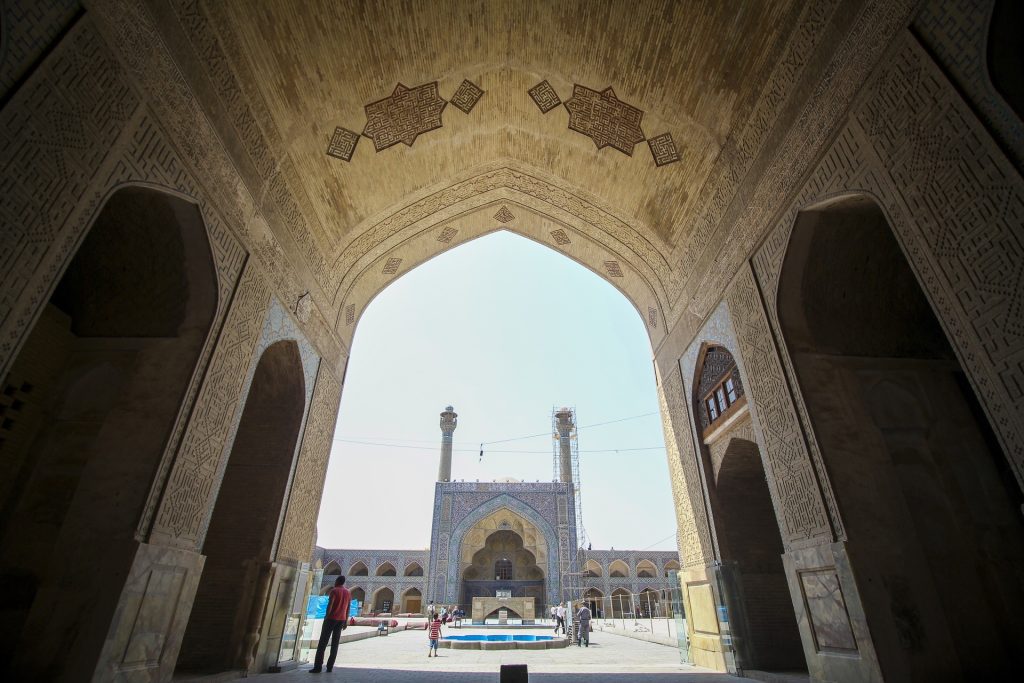
One of the most distinctive features of Masjed-e Jāmé is its four-iwan courtyard, known in Persian as Chahar Ayvan.
An iwan is a large vaulted hall or space that opens onto a courtyard. In this mosque, four monumental iwans face the central courtyard from its four sides.
This arrangement creates a balanced architectural composition. It also provides a clear visual and spatial connection between the courtyard and the surrounding prayer halls.
The four-iwan design represents a major architectural innovation. The mosque is recognized as the first Islamic building to adapt the four-iwan courtyard arrangement associated with Sassanid palaces to Islamic religious architecture.
This design later became an influential model for mosque architecture throughout the region.
The four iwans are not simply decorative elements. They organize the entire architectural experience of the mosque and connect its different spaces.
4. The Nezam al-Molk Dome: A Masterpiece of Seljuk Engineering
The Nezam al-Molk Dome is one of the most important architectural features of Masjed-e Jāmé.
Commissioned during the Seljuk period, it demonstrates the extraordinary engineering skills of Persian builders.
Its double-shell ribbed structure represents an important development in dome construction. The design allowed architects to create impressive interior spaces while developing new approaches to structural support and architectural form.
The dome is particularly significant because of its influence on later Islamic architecture.
Standing beneath it, visitors can appreciate the relationship between engineering, geometry, and artistic expression that defines much of Persian architecture.
5. The Taj al-Molk Dome: Elegance in Brickwork
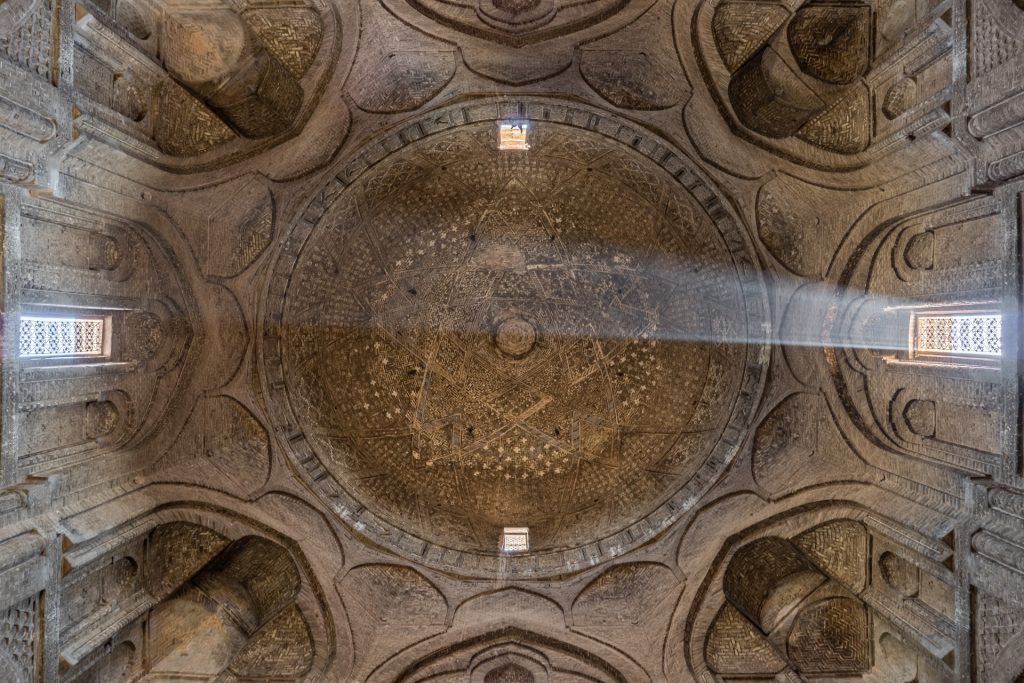
On the northern side of the mosque stands the magnificent Taj al-Molk Dome.
Although smaller than the Nezam al-Molk Dome, it is celebrated for its refined proportions and sophisticated brickwork.
Its geometric patterns demonstrate how Persian architects transformed simple building materials into extraordinary works of art.
The dome’s structural elegance and decorative details reveal the high level of mathematical and technical knowledge achieved by Seljuk craftsmen.
Together, the Nezam al-Molk and Taj al-Molk domes represent two outstanding achievements in the history of Persian architecture.
6. Brickwork, Tilework, and Persian Decoration
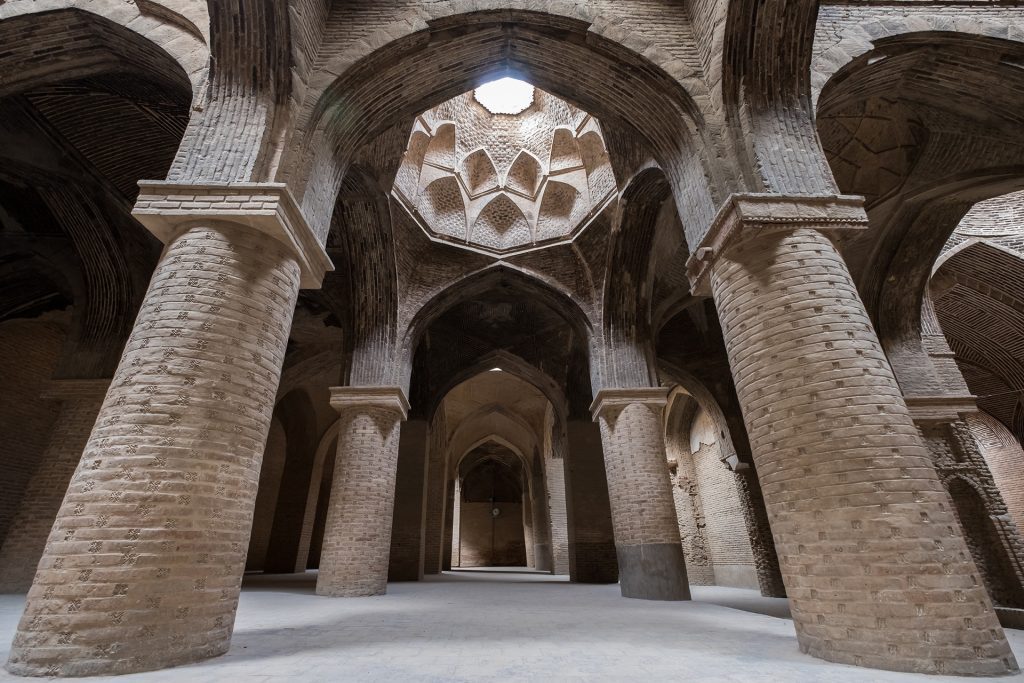
Masjed-e Jāmé is an architectural gallery of traditional Iranian craftsmanship.
Its walls, domes, iwans, and prayer halls display decorative techniques developed and refined over many centuries.
Intricate Brick Patterns
Brick is one of the mosque’s most important architectural materials.
Persian builders used different arrangements of bricks to create geometric patterns, textures, and decorative surfaces. These designs demonstrate that brickwork can be both structural and artistic.
Glazed Tiles and Colour

Later periods introduced colourful glazed tiles that enriched the mosque’s appearance.
Blue, turquoise, and other decorative colours create a striking contrast with the warm tones of brick and plaster.
Stucco and Calligraphy
The mosque also features remarkable stucco decoration and inscriptions.
Arabic and Persian calligraphy contributes to the spiritual and artistic atmosphere of the complex. These inscriptions connect architecture with religious expression, literature, and the cultural traditions of Iran.
Every section offers visitors an opportunity to discover a different artistic language.
7. A Living Mosque Connected to the Historic Bazaar

One of the most remarkable aspects of Masjed-e Jāmé is that it continues to function as a mosque.
It is not simply an archaeological monument or a museum. It remains an active place of worship and an important part of the local community.
Its direct relationship with Isfahan’s historic bazaar is equally significant.
For centuries, the mosque and the surrounding commercial district have formed part of the city’s social and economic life. Merchants, craftspeople, residents, and visitors have shared this historic urban environment.
This connection gives Masjed-e Jāmé a special character. Its heritage is not limited to its architecture; it also includes the traditions and daily activities that continue around it.
8. Why Is Masjed-e Jāmé a UNESCO World Heritage Site?
Masjed-e Jāmé of Isfahan was inscribed on the UNESCO World Heritage List in 2012 under criterion (ii).
This criterion recognizes the site’s exceptional influence on architectural developments and the exchange of human values.
UNESCO highlights two particularly important achievements:
- The adaptation of the four-iwan courtyard layout, associated with Sassanid palace architecture, to Islamic religious buildings.
- The development of innovative double-shell ribbed dome construction, represented by the Nezam al-Molk Dome.
Together, these innovations helped establish an influential architectural model for mosques and other monumental buildings across the Islamic world.
The mosque also preserves an extraordinary sequence of architectural and decorative styles from different periods of Iranian history.
UNESCO inscription: 2012
Category: Cultural Heritage
UNESCO criterion: (ii)
Location: Isfahan, Isfahan Province, Iran
Official UNESCO listing: https://whc.unesco.org/en/list/1397/
9. What Should You Look for During Your Visit?
A visit to Masjed-e Jāmé becomes much more rewarding when you take time to explore its different architectural elements.
Here are some highlights to include in your visit:
- The central courtyard: Discover the four monumental iwans and their relationship with the surrounding spaces.
- Nezam al-Molk Dome: Admire the engineering and architectural innovation of the Seljuk period.
- Taj al-Molk Dome: Observe its elegant proportions and sophisticated brick patterns.
- The four iwans: Explore their individual architectural character and decorative details.
- Historic prayer halls: Discover the different construction techniques and artistic styles.
- Stucco and calligraphy: Look closely at the inscriptions and intricate decorative details.
- The surrounding bazaar: Experience the historic relationship between the mosque and Isfahan’s traditional commercial life.
For architecture enthusiasts, a guided visit can reveal details that are easy to overlook during an independent walk.
10. Best Time to Visit Masjed-e Jāmé
Isfahan is a year-round destination, but spring and autumn are generally among the most comfortable seasons for exploring its historic attractions.
Spring (March–May): Pleasant temperatures and beautiful city scenery make this an excellent season for cultural sightseeing.
Autumn (September–November): Comfortable weather creates ideal conditions for walking through the old city, visiting the bazaar, and exploring Isfahan’s architectural landmarks.
Summer (June–August): Temperatures can become very high. Plan outdoor sightseeing for early morning or later in the afternoon.
Winter (December–February): The city is generally quieter, although temperatures can be cold. Winter can offer a different atmosphere for visitors interested in architecture and history.
Opening arrangements and access conditions may change. Visitors should check locally before planning their visit, especially during prayer times and religious occasions.
11. Responsible Tourism: Preserving a Living Heritage
Masjed-e Jāmé is both a UNESCO World Heritage Site and an active religious space. Responsible visitors should respect its spiritual importance and the local community.
A few simple practices can help protect this extraordinary monument:
- Dress respectfully and follow the mosque’s visitor guidelines.
- Respect worshippers and avoid disturbing prayer activities.
- Follow photography restrictions and ask permission when appropriate.
- Avoid touching fragile architectural and decorative surfaces.
- Do not leave litter or damage historic structures.
- Support local guides and businesses in the surrounding historic district.
- Learn about the mosque’s history and cultural significance before or during your visit.
Responsible tourism helps ensure that future generations can continue to experience and appreciate Iran’s architectural heritage.
12. Explore Masjed-e Jāmé with PGTG

Isfahan is one of Iran’s most rewarding destinations for travellers interested in history, architecture, culture, and traditional lifestyles.
From the magnificent Masjed-e Jāmé to Naqsh-e Jahan Square, the historic bazaar, elegant bridges, and traditional houses, the city offers an extraordinary journey through Persian heritage.
With Persian Gryphon Travel Group (PGTG), you can discover Isfahan through carefully designed cultural and historical experiences.
Our tours connect remarkable monuments with local stories, traditional craftsmanship, Persian architecture, and the everyday life of local communities.
Whether you are a first-time visitor to Iran, an architecture enthusiast, a cultural traveller, or a photographer, Isfahan deserves a special place in your journey.
Don’t just read about Persian architecture — come to Isfahan, walk through its historic monuments, and experience more than a thousand years of history.
Explore Iran with PGTG — where we learn together, experience together, and give meaning to travel.
Contact Persian Gryphon Travel Group to plan your tailor-made journey through Iran.
Leave a Reply