
Golestan Palace: Discover Tehran’s Royal Masterpiece of Persian Art and Architecture
In the historic heart of Tehran stands one of Iran’s most magnificent architectural treasures: Golestan Palace.
Known as the Palace of Flowers, this remarkable royal complex combines elegant gardens, historic buildings, magnificent halls, colourful tilework, intricate mirror mosaics, and beautiful Persian craftsmanship.
Golestan Palace is more than a royal residence. It is a reflection of Iran’s cultural transformation during the 18th and 19th centuries, when traditional Persian artistic traditions encountered new European influences.
Originally developed during the Safavid period, the complex became the royal residence and centre of government of the Qajar dynasty. Its most distinctive architectural features emerged during the 19th century, particularly during the reign of Naser al-Din Shah.
Inscribed on the UNESCO World Heritage List in 2013, Golestan Palace represents an exceptional chapter in the history of Persian architecture and decorative arts.
Discover Golestan Palace with PGTG and experience the royal heritage of Tehran.
1. Where Is Golestan Palace?
Golestan Palace is located in the historic centre of Tehran, the capital of Iran. The complex stands within the older urban district, close to the historic Grand Bazaar and other important landmarks of traditional Tehran.
Its location reflects the historical relationship between royal authority, commerce, and urban life. The palace was originally part of the Arg, the historic walled citadel of Tehran. During the Qajar period, this area became the centre of royal administration and political power.
Today, Golestan Palace is one of Tehran’s most important cultural attractions. Its location makes it easy to combine a visit with the Grand Bazaar, and other historic neighbourhoods. For visitors exploring Tehran, the palace offers an excellent introduction to the city’s royal and architectural history.
2. The History of Golestan Palace: From Safavid Gardens to Qajar Royal Residence
The history of Golestan Palace is closely connected to the development of Tehran itself.
Although its origins reach back to the Safavid period, the complex experienced major changes under successive Iranian dynasties.
Safavid Period: The Early Foundations
The earliest history of the palace is associated with the Safavid dynasty, when Tehran was still a relatively small settlement.
During this period, the city developed as an important residential and strategic location.
A royal garden and buildings were established within the historic walled settlement. These early foundations later became part of the Golestan Palace complex.
Zand Period: Further Development
During the Zand dynasty in the 18th century, Tehran gained greater political importance.
Karim Khan Zand contributed to the development of the royal citadel and its buildings.
The Marble Throne Terrace, known as Takht-e Marmar, has historical connections with this period, although it underwent later Qajar alterations and decoration.
Qajar Period: The Golden Age of Golestan Palace
The Qajar dynasty came to power in the late 18th century and selected Tehran as its capital.
Golestan Palace subsequently became the royal residence and centre of government.
The complex expanded significantly during the 19th century, with new buildings, reception halls, gardens, decorative features, and royal spaces.
It became a centre of political activity, royal ceremonies, artistic production, and cultural exchange.
Naser al-Din Shah: A New Architectural Vision
One of the most influential rulers in the development of Golestan Palace was Naser al-Din Shah, who ruled from 1848 to 1896.
His interest in European architecture, technology, photography, and artistic traditions influenced the palace’s appearance.
Following his European journeys, new architectural ideas and decorative approaches were introduced into the complex.
The result was a distinctive combination of traditional Persian craftsmanship and European-inspired design.
Golestan Palace therefore provides an exceptional insight into Iran’s encounter with modernity during the Qajar era.
3. The Architectural Beauty of Golestan Palace
Golestan Palace is a remarkable example of architectural synthesis.
Its buildings combine Persian spatial traditions with European motifs, materials, and construction techniques.
The complex includes eight principal palace structures arranged around the historic Golestan Garden.
Its most distinctive features include:
- Elegant courtyards and gardens.
- Colourful glazed tile decorations.
- Intricate mirror mosaics.
- Elaborate plasterwork and painted ceilings.
- Marble architectural elements.
- European-inspired architectural details.
- Historic royal halls and ceremonial spaces.
Each building has its own architectural identity, reflecting different stages in the palace’s development.
4. The Main Attractions of Golestan Palace
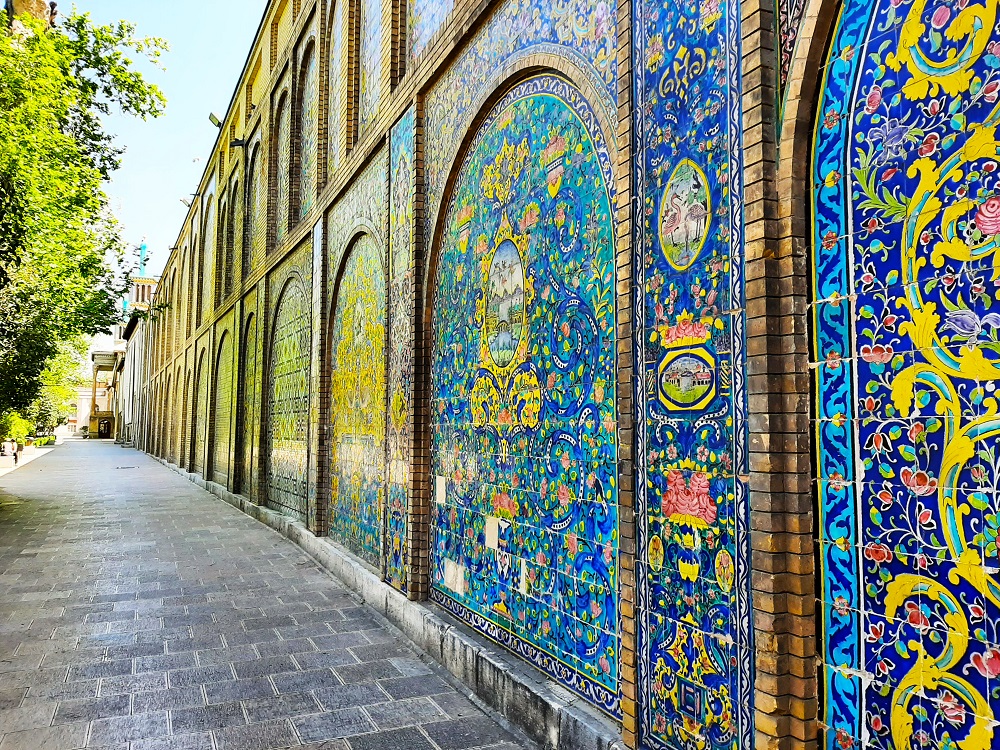
Exploring Golestan Palace means discovering a collection of remarkable royal buildings, each with its own story.
Here are some of the most important highlights.
4.1. Takht-e Marmar: The Marble Throne Terrace
One of the most famous sections of Golestan Palace is Takht-e Marmar, or the Marble Throne Terrace. This elegant open-air structure is among the oldest surviving architectural elements of the complex. Its most recognizable feature is the magnificent marble throne, created during the Qajar period using carved pieces of yellow marble.
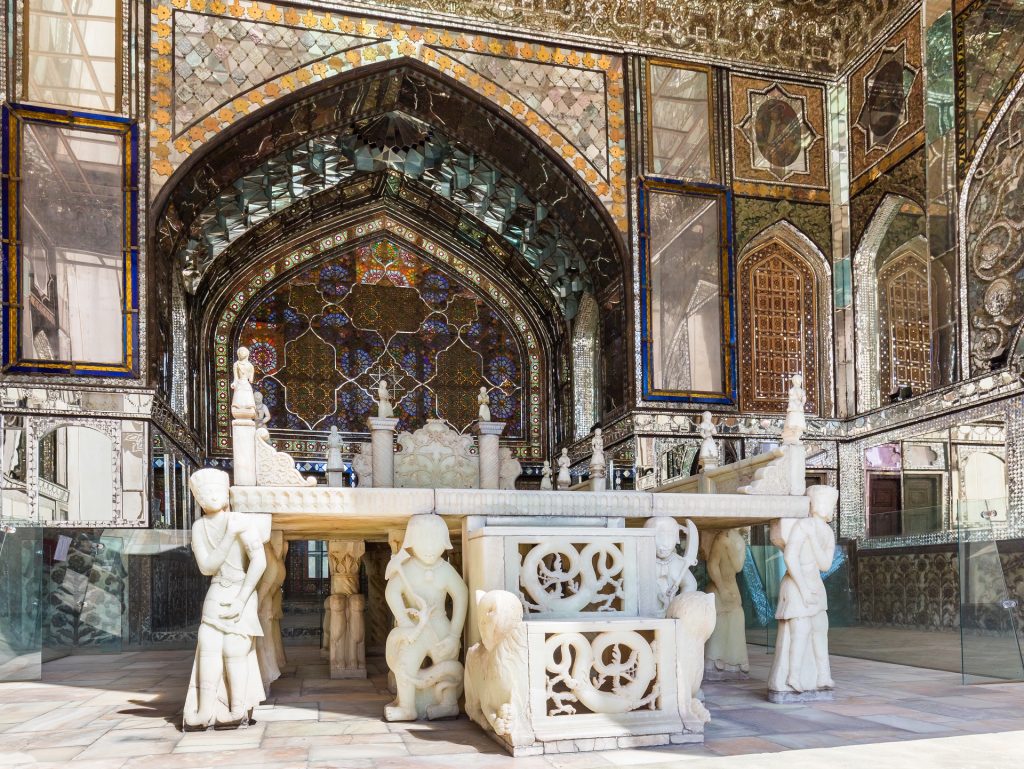
The throne is supported by sculpted human and mythical figures and reflects the artistic traditions of royal Persian decoration. The terrace was used for important royal ceremonies and audiences. Its combination of carved stone, colourful tilework, painted surfaces, and architectural details makes it one of the most impressive places within the palace.
4.2. Shams-ol Emareh: The Sun Building
Shams-ol Emareh, meaning the Edifice of the Sun, is one of the most recognizable buildings in the Golestan Palace complex. Commissioned by Naser al-Din Shah, it reflects his interest in European architecture and urban landmarks.
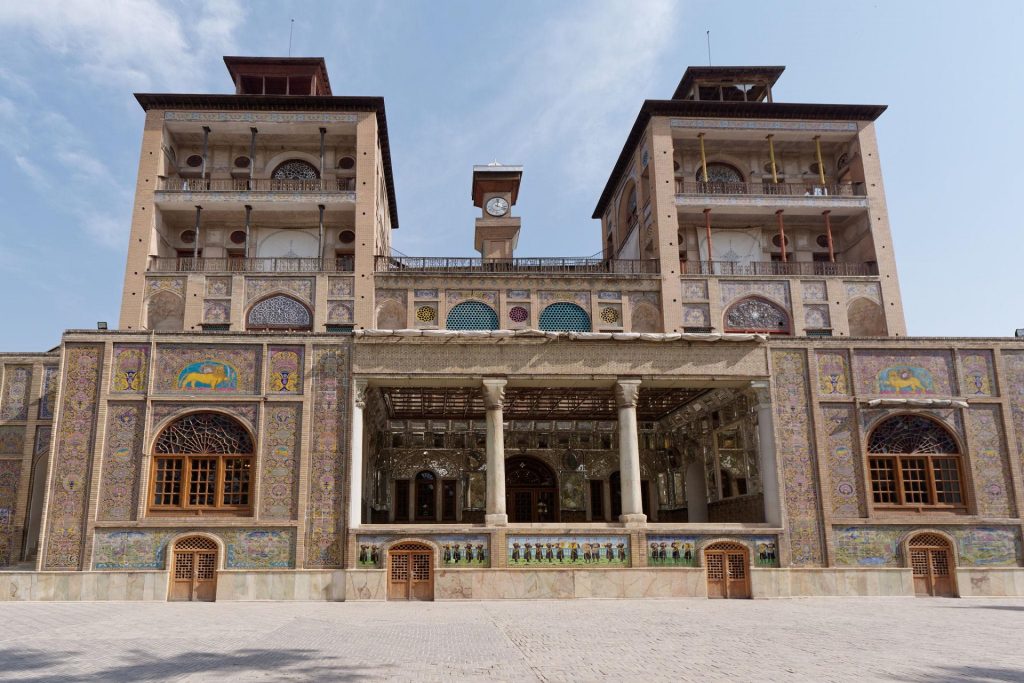
Its symmetrical design, tall structure, decorative towers, clocks, and architectural details distinguish it from traditional Persian palace buildings. When constructed, Shams-ol Emareh was among the tallest buildings in Tehran and provided impressive views over the surrounding city. It represents the Qajar desire to combine traditional royal architecture with new European-inspired forms.
4.3. Talar-e Aineh: The Hall of Mirrors
The Hall of Mirrors is one of the palace’s most celebrated interior spaces.
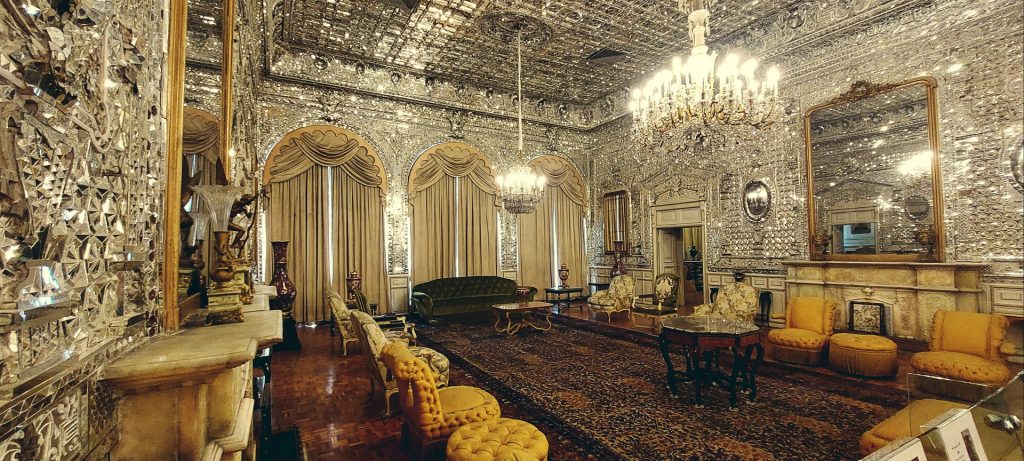
Its walls and ceilings are decorated with thousands of small mirror pieces arranged in intricate patterns. The reflective surfaces create an extraordinary visual experience, multiplying the effects of light and architecture.
The hall demonstrates the extraordinary skills of Persian craftsmen, particularly in the traditional art of mirrorwork. Its refined decoration reflects the importance of light, geometry, and visual harmony in Persian interior design.
4.4. Emarat-e Badgir: The Windcatcher Building
The Windcatcher Building is another architectural highlight of Golestan Palace.
Its name refers to the traditional windcatcher structures used in Persian architecture to improve natural ventilation.
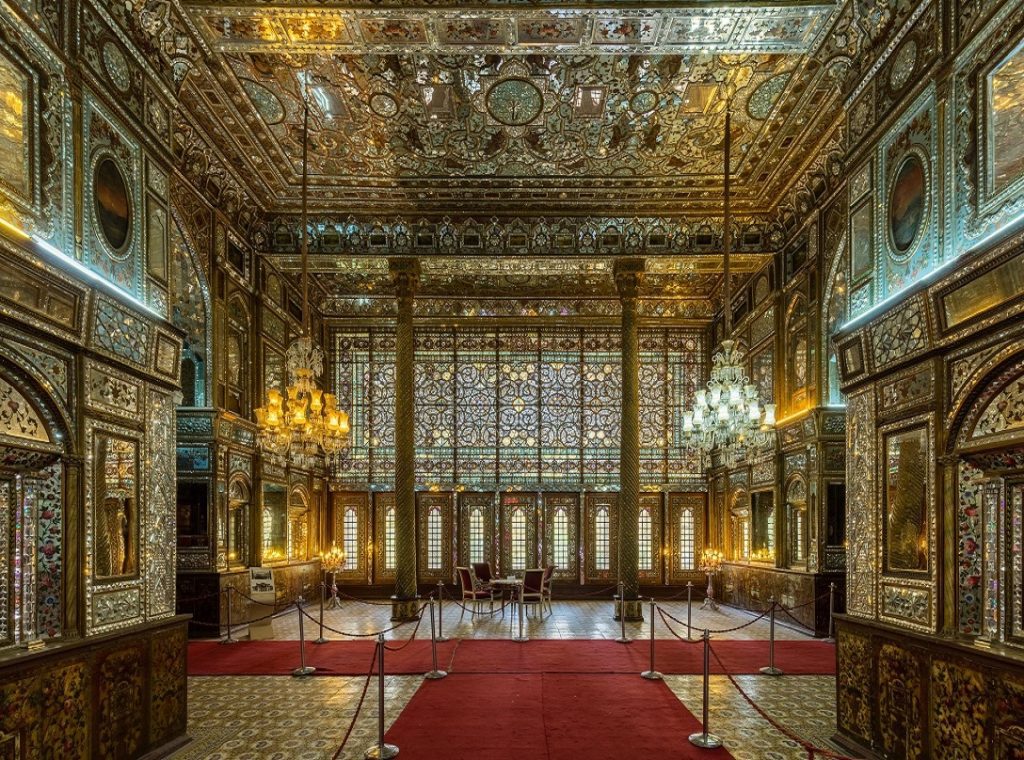
The building is particularly notable for its elegant windcatchers, colourful decorations, and beautiful interior spaces.
Its architecture demonstrates the combination of traditional Iranian environmental knowledge with the decorative ambitions of the Qajar court.
The structure also features impressive stained-glass windows and intricate interior ornamentation.
4.5. Talar-e Brelian: The Brilliant Hall
The Brilliant Hall is famous for its elaborate mirrorwork and luxurious decoration.
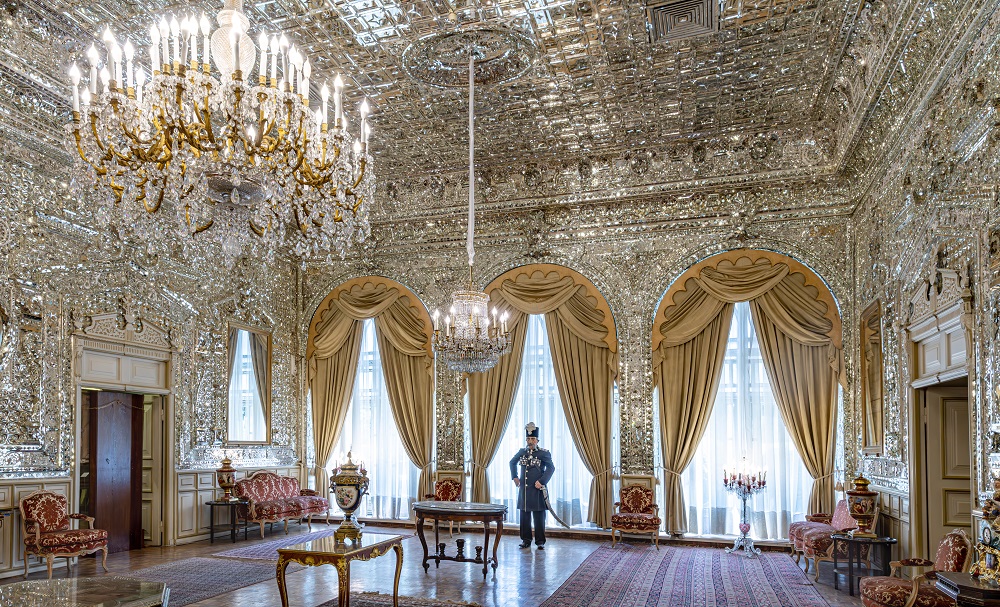
Its name reflects the brilliance of its reflective interior surfaces. The hall demonstrates the exceptional craftsmanship of Qajar-era artists, who transformed small pieces of mirror into elaborate decorative compositions. Light reflects across its walls and ceilings, creating a spectacular atmosphere. It is one of the finest examples of the decorative arts preserved within Golestan Palace.
4.6. Talar-e Almas: The Diamond Hall
The Diamond Hall is another important interior space within the complex.
Its architecture and decoration combine traditional Persian elements with later artistic influences. The hall is particularly associated with its decorative mirrorwork, elegant surfaces, and carefully designed interior details.
It provides another perspective on the development of Qajar palace architecture.
4.7. Khalvat-e Karim Khani: Karim Khan’s Private Retreat
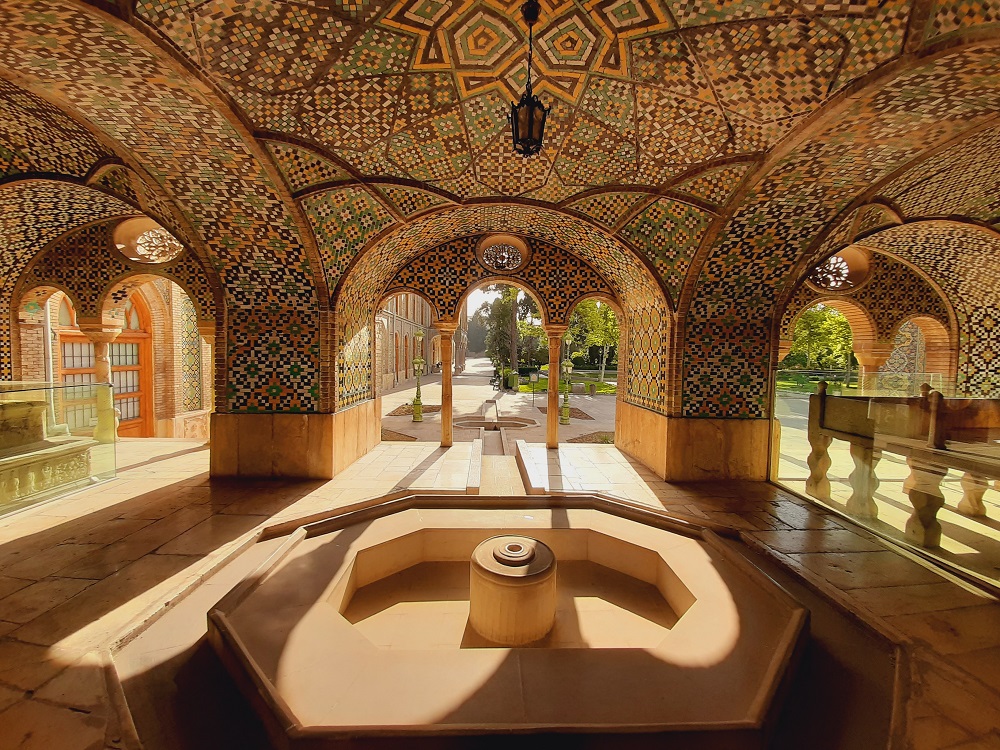
Known as Karim Khan’s Nook, this intimate space is associated with Karim Khan Zand.
It was originally designed as a quieter area within the royal complex.
One of its notable features is the marble tombstone of Naser al-Din Shah, which was transferred to this location.
The contrast between this relatively modest architectural space and the palace’s grand ceremonial halls makes it particularly interesting.
4.8. Kakhe Abyaz: The White Palace
The White Palace, also known as Kakhe Abyaz, is another important building within the complex.
Its name refers to its light-coloured exterior appearance.
It was constructed during the Qajar period and reflects the architectural and artistic preferences of the royal court.
Today, it forms part of the wider museum experience of Golestan Palace.
5. Golestan Garden: The Green Heart of the Royal Complex
At the centre of Golestan Palace lies its historic garden.
The garden provides a peaceful contrast to the elaborate architecture surrounding it.
Traditional Persian garden principles are reflected in its relationship between water, vegetation, pathways, and architectural spaces.
Pools, trees, and planted areas create a carefully organized landscape.
Water plays an important visual and environmental role. Its presence brings freshness and balance to the palace environment.
The garden also reflects the historical importance of nature in Persian royal architecture.
For centuries, Persian gardens have represented beauty, order, tranquillity, and an ideal relationship between human beings and nature.
Golestan Garden continues this tradition within an urban royal setting.
6. Photography, Art, and Modernization in the Qajar Era
Golestan Palace is particularly important for understanding the cultural transformation of Iran during the 19th century.
During Naser al-Din Shah’s reign, photography became increasingly important at the royal court.
The ruler himself developed an interest in photography, while the palace became associated with the development of early photographic practices in Iran.
Photography provided a new way to document royal ceremonies, architecture, people, and everyday life.
The palace also became a centre for painting, decorative arts, architectural experimentation, and artistic production.
These developments demonstrate how traditional Persian artistic practices adapted to new technologies and cultural influences.
Golestan Palace therefore offers more than architectural beauty. It provides a window into the changing cultural identity of Iran during the Qajar period.
7. Why Is Golestan Palace a UNESCO World Heritage Site?
Golestan Palace was inscribed on the UNESCO World Heritage List in 2013.
The inscription recognizes its exceptional contribution to Persian architecture, artistic development, and cultural exchange.
UNESCO identifies three criteria:
Criterion (ii): Exchange of human values
Golestan Palace represents an important synthesis of Persian artistic traditions and European architectural influences.
Its design incorporates traditional Persian craftsmanship alongside European motifs, architectural ideas, and building technologies.
Criterion (iii): Exceptional testimony to a civilization
The palace preserves an outstanding representation of Qajar artistic and architectural production.
It provides evidence of the political, cultural, and artistic achievements of the Qajar period.
Criterion (iv): Outstanding example of a significant historical period
Golestan Palace represents a major period of transformation in Iranian society during the 19th century.
Its architecture demonstrates how traditional Persian values and artistic traditions were integrated with contemporary Western influences.
UNESCO inscription: 2013
Category: Cultural Heritage
UNESCO criteria: (ii), (iii), (iv)
Location: Tehran, Tehran Province, Iran
UNESCO property number: 1422
Official UNESCO listing: https://whc.unesco.org/en/list/1422/
8. What Should You Look for During Your Visit?
Golestan Palace offers a rich experience for visitors interested in history, architecture, photography, and decorative arts.
To make the most of your visit, pay attention to these details:
- Mirror mosaics: Observe the intricate patterns covering the walls and ceilings of important halls.
- Persian tilework: Discover colourful scenes, floral motifs, and historical representations.
- The Marble Throne: Examine the detailed stone carving and royal symbolism.
- Shams-ol Emareh: Admire its distinctive European-inspired architecture.
- Stained glass: Explore the colourful light effects created by traditional window designs.
- Royal paintings: Discover portraits and artistic representations of Qajar rulers.
- The garden: Enjoy the peaceful atmosphere of its historic landscape.
A guided visit can help you understand the historical meaning behind the palace’s architectural details and artistic collections.
9. Golestan Palace and Other Attractions in Tehran
A visit to Golestan Palace can easily become part of a wider cultural exploration of Tehran.
The capital offers a fascinating combination of historic monuments, museums, traditional markets, modern architecture, and contemporary urban life.
Consider including these attractions in your Tehran itinerary:
Tehran Grand Bazaar
Located close to Golestan Palace, the Grand Bazaar offers a fascinating experience of traditional commerce, handicrafts, and local culture.
National Museum of Iran
Discover archaeological collections that trace the history of Iran from prehistoric periods through the Islamic era.
National Jewelry Museum
Explore an extraordinary collection of royal jewels and historical treasures, subject to its opening arrangements.
National Garden and Historic Government Buildings
Discover the architecture and urban history of the former government district.
Saadabad Palace Complex
Explore another important royal complex, located in northern Tehran and surrounded by landscaped gardens.
Niavaran Palace Complex
Discover the royal architecture and collections associated with the later Pahlavi period.
These attractions provide a broader understanding of Tehran’s transformation from a historic settlement into Iran’s modern capital.
10. Best Time to Visit Golestan Palace
Tehran can be visited throughout the year, but spring and autumn are generally the most comfortable seasons for exploring its historic attractions.
Spring (March–May): Pleasant temperatures and blooming vegetation make this an excellent time to enjoy Golestan Garden and the surrounding historic district.
Summer (June–August): Temperatures can become high, especially during the afternoon. Plan outdoor sightseeing for the morning.
Autumn (September–November): Comfortable weather and changing colours in the gardens create attractive conditions for cultural exploration.
Winter (December–February): Tehran can be cold, but the palace interiors and museums remain appealing destinations when visitor access is available.
Opening times, museum access, and photography arrangements may change. Check the latest local information before your visit.
11. Responsible Tourism: Preserving Iran’s Royal Heritage
Golestan Palace is an irreplaceable part of Iran’s cultural identity.
Its preservation depends on careful conservation, responsible management, and respect from visitors.
As responsible travellers, we can contribute through simple actions:
- Respect visitor regulations and museum instructions.
- Avoid touching historic decorations, mirrorwork, and fragile surfaces.
- Do not use flash photography where prohibited.
- Keep the historic garden clean.
- Respect other visitors and museum staff.
- Support local guides and cultural businesses.
- Learn about the historical and artistic context of the palace.
- Share responsible travel messages that encourage heritage protection.
Responsible tourism helps protect cultural monuments while creating meaningful benefits for local communities.
12. Explore Golestan Palace with PGTG
Tehran is often the starting point of an unforgettable journey through Iran.
Beyond its modern urban life, the capital preserves extraordinary stories of Persian civilization, royal history, architecture, and cultural transformation.
Golestan Palace is one of the best places to discover these stories.
With Persian Gryphon Travel Group (PGTG), you can explore Tehran through carefully designed cultural and historical experiences.
Our tours connect architectural landmarks with local stories, traditional craftsmanship, museums, historic markets, and the everyday life of Iranian communities.
Whether you are a first-time visitor, a history enthusiast, an architecture lover, or a photographer, Golestan Palace deserves a place on your Iran itinerary.
Don’t just admire Persian royal architecture in photographs — come to Tehran, explore Golestan Palace, and experience the artistic legacy of the Qajar era.
Discover Iran with PGTG — together we learn, experience, and give meaning to travel.
Contact Persian Gryphon Travel Group to plan your tailor-made journey through Iran.
Golestan Palace is more than a royal residence. It is a reflection of Iran’s artistic identity, cultural exchange, and historical transformation.
Discover the royal heritage of Tehran with PGTG — Persian Gryphon Travel Group.
Leave a Reply