
Discover Iran’s Iconic UNESCO World Heritage Site
Few places in the world can make history feel as immediate as Persepolis.
Rising from the plains of Fars Province beneath the Mountain of Mercy, the monumental ruins of Persepolis preserve the extraordinary vision of the Achaemenid kings. Massive stone stairways, imposing columns, royal halls, intricate reliefs, and ancient inscriptions reveal the power and sophistication of one of the world’s greatest early empires.
Founded by Darius I in 518 BCE, Persepolis became the ceremonial heart of the Achaemenid Empire. Darius and his successors, including Xerxes I and Artaxerxes I, expanded the monumental complex over generations. UNESCO describes Persepolis as one of the world’s greatest archaeological sites and an exceptional testimony to an ancient civilization.
Today, Persepolis is one of Iran’s most important cultural destinations and a defining experience for travelers exploring Persian history.
Where Is Persepolis?
Persepolis is located in Fars Province, approximately 60 kilometers northeast of Shiraz.
Its location places it within one of Iran’s richest historical regions, surrounded by other extraordinary archaeological and cultural sites.
A visit to Persepolis can easily be combined with:
- Shiraz
- Pasargadae
- Naqsh-e Rostam
- Naqsh-e Rajab
- Persian gardens
- Traditional villages
- Local culinary experiences

This makes Persepolis an essential part of a cultural journey through southern Iran.
When Was Persepolis Built?
The construction of Persepolis began around 518 BCE, during the reign of Darius I.
Rather than being completed by a single ruler, the monumental complex developed across several generations.
Darius began the great terrace and major structures. His son Xerxes I continued the construction, while Artaxerxes I added further buildings.
The result was an extraordinary architectural ensemble created over decades and shaped by successive Achaemenid kings.
Persepolis and the Achaemenid Empire
The Achaemenid Empire was one of the largest empires of the ancient world.
At its height, it extended across vast territories from the eastern Mediterranean toward Central and South Asia.
Persepolis represented the grandeur of this empire.
The city was not simply a collection of palaces. It was a carefully planned ceremonial complex where royal receptions, festivals, diplomatic encounters, and imperial ceremonies could take place.
UNESCO notes that Persepolis was primarily designed as a spectacular center for royal receptions and festivals, while also serving an important governmental role.
The Great Terrace of Persepolis

The first impression of Persepolis comes from its enormous stone terrace.
Partly natural and partly artificial, the terrace creates an imposing platform against the mountain landscape.
Visitors approach through monumental stairways before entering a world of columns, gateways, royal halls, sculptures, and reliefs.
The scale of the terrace is one of the reasons Persepolis remains such an extraordinary archaeological achievement.
The architectural design demonstrates advanced knowledge of construction, engineering, stone carving, and spatial planning.
The Gate of All Nations
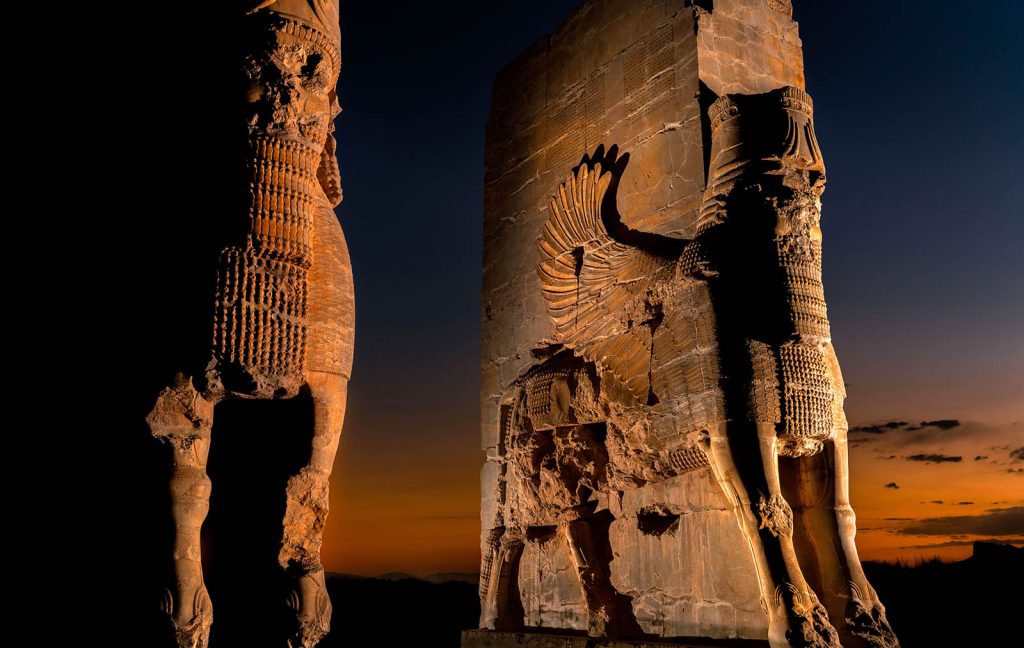
One of the most memorable structures at Persepolis is the Gate of All Nations, associated with Xerxes I.
The monumental gateway welcomed visitors arriving at the ceremonial complex.
Its name is particularly appropriate when considering the reliefs throughout Persepolis, where delegations from different parts of the Achaemenid Empire appear bringing gifts and tribute.
The imagery provides a fascinating window into how the empire represented its diverse peoples.
The Apadana: A Symbol of Imperial Grandeur
The Apadana was one of the most impressive structures at Persepolis.
This enormous audience hall featured monumental stairways and beautifully carved reliefs.
The reliefs depict delegations from different regions of the empire approaching the king.
Rather than presenting chaotic scenes of conquest, the artistic program emphasizes order, ceremony, dignity, and the diversity of the empire.


For visitors today, these reliefs are among the most powerful experiences at Persepolis.
The Reliefs: Stories Written in Stone
Perhaps the greatest treasure of Persepolis is its extraordinary collection of stone reliefs.
Guards, dignitaries, royal figures, animals, and delegations are depicted with remarkable precision.
The clothing, hairstyles, objects, and gestures represented in these sculptures provide valuable evidence of the people and cultures incorporated into the Achaemenid world.
Walking slowly along the reliefs allows travelers to appreciate details that can easily be missed during a quick visit.

This is one reason why exploring Persepolis with a knowledgeable local guide can transform the experience.
The Hundred-Column Hall
The Hundred-Column Hall, also known as the Throne Hall, was one of the largest structures on the Persepolis terrace.
Its monumental columns once supported a vast roofed space.
Although the roof has disappeared, the surviving columns, doorways, reliefs, and architectural elements allow visitors to imagine the extraordinary scale of the original building.
UNESCO specifically identifies the Apadana and Hundred-Column Hall among the major architectural components that contribute to Persepolis’s Outstanding Universal Value.

The Persian Kings of Persepolis
Several Achaemenid rulers contributed to the development of Persepolis.
Darius I — The Founder
Darius initiated the monumental terrace and established Persepolis as a major royal center.
Xerxes I — The Great Builder
Xerxes continued his father’s ambitious architectural program and added important structures, including the Gate of All Nations.
Artaxerxes I — Continuing the Legacy
Artaxerxes I continued construction and contributed to the development of the royal complex.
Together, these rulers transformed Persepolis into one of the most extraordinary architectural expressions of the Achaemenid Empire.
What Happened to Persepolis?
The Achaemenid Empire eventually came into conflict with the armies of Alexander the Great.
Persepolis was captured in 330 BCE during Alexander’s campaign.
Much of the city was subsequently destroyed by fire, although the archaeological remains that survived provide an extraordinary record of Achaemenid civilization.
The ruins became one of the most important archaeological windows into ancient Persian history.
UNESCO’s historical documentation records the destruction associated with Alexander’s conquest and emphasizes Persepolis’s role as the symbolic dynastic center of the Achaemenid Empire.
Why Are the Persepolis Reliefs So Important?
The reliefs are more than beautiful decoration.
They communicate an image of the Achaemenid Empire as a diverse and organized political world.
Delegations representing different peoples appear in carefully arranged processions.
Their clothing and objects help researchers understand the cultural diversity of the empire.
For modern travelers, the reliefs also create a remarkable connection between ancient history and the people of the present.
Thousands of years later, visitors can still stand in front of the same carved figures and observe details created by ancient artists.
Persepolis and UNESCO World Heritage
Persepolis was among Iran’s first three UNESCO World Heritage inscriptions in 1979, alongside Meidan Emam in Isfahan and Tchogha Zanbil.
UNESCO recognizes Persepolis under three criteria:
Criterion (i): Its monumental architecture represents an outstanding creative achievement.
Criterion (iii): The archaeological ensemble provides exceptional testimony to an ancient civilization.
Criterion (vi): Persepolis has a direct and powerful association with the history and identity of the Achaemenid monarchy.
Today, Persepolis remains one of Iran’s most important World Heritage destinations.
Persepolis Beyond the Ruins
A meaningful visit to Persepolis should not end at the main terrace.
The surrounding region contains several other important archaeological and cultural sites.
Naqsh-e Rostam
The dramatic rock face of Naqsh-e Rostam contains monumental royal tombs associated with the Achaemenid kings, as well as later Sasanian reliefs.
Naqsh-e Rajab
Nearby Naqsh-e Rajab contains important Sasanian rock reliefs.
Pasargadae
The ancient royal complex of Pasargadae, founded by Cyrus the Great, provides an essential earlier chapter in the development of Achaemenid royal architecture. UNESCO inscribed Pasargadae in 2004.
Together, these sites create a remarkable journey through the evolution of Persian imperial architecture.
The Best Way to Experience Persepolis
Persepolis rewards travelers who take their time.
Rather than simply walking from one monument to another, consider exploring the site as a historical story.
A local guide can help explain:
- The Achaemenid royal family
- The meaning of the reliefs
- Ancient Persian architecture
- The structure of the empire
- Ancient inscriptions
- Construction techniques
- Religious and ceremonial traditions
- The historical context of Alexander’s conquest
The experience becomes much more meaningful when the stones begin to tell their stories.
Persepolis at Sunrise and Sunset


The changing light is one of the most beautiful aspects of Persepolis.
Early morning light can reveal delicate details in the stone reliefs, while late afternoon creates long shadows across the ancient columns.
The surrounding mountains and open landscape add another dimension to the experience.
For photographers and travelers interested in visual storytelling, Persepolis offers extraordinary opportunities.
Responsible Travel at Persepolis
Persepolis is an archaeological treasure that belongs to humanity.
Visitors can help protect the site by following simple responsible travel principles:
- Do not touch or climb ancient reliefs.
- Follow designated visitor routes.
- Never remove stones or archaeological objects.
- Respect conservation areas.
- Avoid littering.
- Follow photography and visitor regulations.
- Listen to local guides and site staff.
- Encourage responsible tourism practices.
Preserving Persepolis allows future generations to experience the same remarkable connection with ancient Persian civilization.
Why Persepolis Should Be on Your Iran Travel List
Persepolis is not simply an archaeological site.
It is a place where architecture, art, politics, engineering, history, and cultural identity come together.
Standing beneath the surviving columns and looking across the ancient terrace, travelers can begin to imagine the ceremonies that once brought representatives from across a vast empire to this remarkable place.
More than 2,500 years later, Persepolis continues to inspire.
Persepolis and the PGTG Experience
At Persian Gryphon Travel Group (PGTG), we believe visiting Persepolis should be more than checking an ancient monument off a travel list.
It should be a journey through history.
Our cultural experiences can combine Persepolis with Shiraz, Pasargadae, Naqsh-e Rostam, Persian gardens, local cuisine, traditional communities, and other destinations across Fars Province.
We focus on creating journeys that connect travelers with:
History — Understanding the civilizations behind the monuments.
Culture — Meeting people and discovering living Persian traditions.
Local Experiences — Exploring food, crafts, villages, and everyday life.
Responsible Travel — Respecting heritage and supporting local communities.
Authentic Experiences — Going beyond the standard sightseeing itinerary.
Plan Your Persepolis Journey with PGTG
A journey through Iran’s ancient heritage becomes even more rewarding when Persepolis is part of a wider cultural itinerary.
Combine your visit with Shiraz, Pasargadae, Naqsh-e Rostam, Yazd, Isfahan, and other UNESCO World Heritage Sites to experience the extraordinary continuity and diversity of Persian civilization.
With Persian Gryphon Travel Group, discover Iran through its history, landscapes, communities, and living culture.
Travel responsibly. Experience authentically. Discover Iran with PGTG.
Leave a Reply